

Operations management has become the backbone of organizational success, shaping how products are delivered, how teams collaborate, and how businesses respond to change. The position of a business operations manager today is much broader in scope than the supervision of processes; they are the drivers of efficiency and strategic alignment, ensuring that every level of the organization functions at the highest possible level with the latest tools. Any business aiming to achieve sustainable growth must understand the key principles and processes of operational management.
Below, we break down the principles, strategies, and solutions that define effective operations in 2026 and beyond.
The Role of Operations Management in Modern Business
Operations management is the art of designing, controlling, and improving the systems that manufacture goods or provide services. It can be an industrial facility, technology advisory service, or a logistics company; in any case, this sphere makes sure that all resources, time, human resources, technology, and materials are utilized effectively.
For a business operations manager, it is a trade-off between day-to-day activities and strategic objectives. They manage planning, budgeting, quality, and performance checks, and ensure uninterrupted communication between departments. Organizations’ roles have increased with the adoption of digital tools, automation, and integrated platforms.
Process Design and Efficiency: The Foundation of Strong Operations
Process design is one of the most significant aspects of operations management. Efficient processes minimize expenditures, eliminate duplication, and increase productivity. Poorly designed workflows cause delays, errors, and bottlenecks for teams, leading to higher costs and lower customer satisfaction.
The role of Modern Operations Management Solutions in enhancing process design is significant. The systems chart workflows, identify inefficiencies, automate workflows, and provide interdepartmental visibility. It allows managers to monitor performance in real time, rapidly change processes, and maintain continuity even under high operational pressure.
Good process design contains:
 Well-defined job obligations.
Sequencing of activities logically.
Quality benchmarks
Consistent feedback loops
When properly implemented, it forms a strong foundation for sustainable organizational performance.
Capacity Management: Ensuring the Right Resources at the Right Time
Capacity management helps businesses align their resources with demand. A company that lacks sufficient resources is characterized by wasted time and lost revenue. Conversely, overcapacity will result in wastage, underutilization of employees, and unnecessary overheads.
An efficient business operations manager will employ forecasting tools, historical data, and real-time dashboards to determine the optimal capacity for specific time periods. Capacity management balances operational readiness and cost-effectiveness, whether driven by seasonal demand surges, new-market expansion, or staffing.
High-technology Operations Management Solutions help in this by analyzing usage, anticipating requirements, and automating scheduling to prevent.
Continuous Improvement and Quality Control.
Quality management is a way of ensuring that products and services are delivered as per customers’ expectations. It has become a necessary part of the operation, particularly as competition grows, and customer tolerance for the error diminishes.
Quality control involves:
Establishing quantifiable goals.
Monitoring outputs
Inspecting deliverables
Using corrective measures when it is relevant.
Continuous improvement is usually supported by such methodologies as Lean, Six Sigma, or Kaizen. Organizations improve over time. A proactive business operations manager employs data analytics to detect patterns, assess defects, predict risks, and optimize processes without disrupting operations.
The updated tools facilitate progressive enhancement by providing fast information, making it easier to make decisions, and enabling quality reporting through team automation.
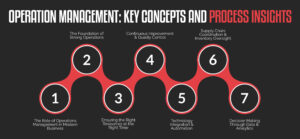
Technology Integration and Automation
The use of technology has ceased to be a choice in operations management. The use of automation tools, cloud services, and AI-driven analytics has changed the way business is done.
The current leaders are adopting Operations Management Solutions to:
Streamline scheduling
Track KPIs
Enable collaboration among remote teams
Reduce manual paperwork
Increase accuracy and efficiency
To name a few, repetitive tasks such as report generation, inventory checks, or service ticket routing can be automated. This allows employees to focus on strategic tasks rather than administrative ones.
A business operations manager must identify which technologies align with organizational goals and integrate them in a way that enhances, not disrupts, existing workflows.
Supply Chain Coordination and Inventory Oversight
The operations include more than the internal workflow and extend to upstream and downstream supply-chain partners. An important component of operations optimization is managing supplier relationships, logistics planning, and inventory levels.
Good supply-chain management enables organizations to:
Reduce delivery delays
Keep the stocks at the right level.
Improve cost control
Be responsive to market changes.
With digital Operations Management Solutions, managers can get a glimpse of suppliers’ timelines, stock movements, and transportation restrictions. This information enables them to make sound decisions, minimize risk, and maximize reliability.
Decision Making Through Data and Analytics
The contemporary business operations manager has emerged as a decision-making manager whose work is data-driven. Real-time dashboards, performance metrics, and sophisticated analytics can be used to detect problems early, forecast future performance, and allocate resources strategically.
Analytics support areas like:
Budget planning
Workforce allocation
Customer experience enhancement
Operational forecasting
Using the appropriate systems, companies can avoid speculation and make decisions based on trends, statistics, and quantifiable results.
Conclusion
Operations management is at the heart of organizational success. It influences the effectiveness of delivering value within a business, across process design, capacity planning, quality assurance, and technology integration. A business operations manager is very important in ensuring that all these things are coordinated and, at the same time, aligned with long-term goals.
The use of modern Operations Management Solutions brings about transparency, uniformity, and control throughout the operational levels of companies. In the current competitive environment, intelligent, well-organized operations are not only an asset but a key to long-term stability and lasting development.
 The Rise of Autonomous Cyber Defense in Managed Cybersecurity Services - Cybercriminals are already using AI to launch faster, smarter, and more sophisticated attacks. The question businesses face today isn’t whether they will be targeted; it’s whether their defenses can respond quickly enough. Cyber threats are advancing at a pace where human response alone is often not enough, especially as IBM’s 2025 threat intelligence insights highlight […]
 How Managed Cybersecurity Service Improves ROI for Small Business Tech Investments - What if the biggest reason your tech stack isn’t paying off has nothing to do with the tools themselves? Small businesses are spending a lot of money on cloud platforms, collaboration software, and automation in 2026, yet many of them cannot derive tangible benefits. The missing link is often invisible until something breaks: security. A […]
 Cybersecurity on a Budget: Strategies for an Economic Downturn - When budgets tighten, cybercriminals don’t slow down; they get smarter. Economic recessions provide the ideal storm for businesses: limited resources, heightened pressure, and more attacks on organizations that skimp on security. This is why it is even more important to consider investing in managed cybersecurity services when the budget is limited, not less. During unstable […]
